


- Harmonic balancers primarily suppress crankshaft torsional vibration, which can otherwise accelerate engine wear and timing instability.
- OEM replacement parts must match fitment, damping behavior, and material specification, not just basic dimensions.
- B2B buyers should evaluate quality systems, documentation, and part catalogs by vehicle application to reduce misfit risk.
- Clear technical data, test references, and application-based navigation improve both SEO performance and procurement confidence.
OEM replacement harmonic balancer selection depends on vibration control, fitment accuracy, and durability, especially in engines that see repeated heat cycles and load changes. In engine development and service contexts, torsional vibration is a known stress source, and balancing accuracy matters because even small rotational irregularities can compound over time. For reference, ISO 1940-1 defines balance quality grades for rigid rotors, while crankshaft-related vibration control is commonly validated through dyno and durability testing. On the supply side, buyers often compare harmonic balancer options, flywheel and flexplate assemblies, and timing cover components to keep the full rotating system consistent.
Why OEM Replacement Harmonic Balancer Selection Matters in Vehicle Maintenance Parts
The right harmonic balancer protects the engine from a failure mode that is easy to overlook and expensive to ignore. Crankshaft torsional vibration is not visible during a normal walk-around inspection, but it can drive belt noise, accessory wear, seal leakage, and in severe cases crankshaft fatigue. In maintenance fleets and repair networks, this is why harmonic balancer replacement is often treated as a reliability task rather than a cosmetic one.
For global vehicle maintenance parts programs, the main challenge is compatibility. A balancer that looks correct may still have the wrong hub offset, bolt pattern, pulley alignment, or damping behavior. That is why OEM replacement harmonic balancer listings should be organized by engine code, displacement, model year, and platform, not only by vehicle make.
How an OEM Replacement Harmonic Balancer Works on the Crankshaft
An OEM replacement harmonic balancer works by absorbing and dissipating torsional energy created by combustion pulses. The crankshaft does not rotate at a perfectly uniform speed; each firing event creates a small acceleration and deceleration. Over time, that repeated twist can excite resonance at certain engine speeds.
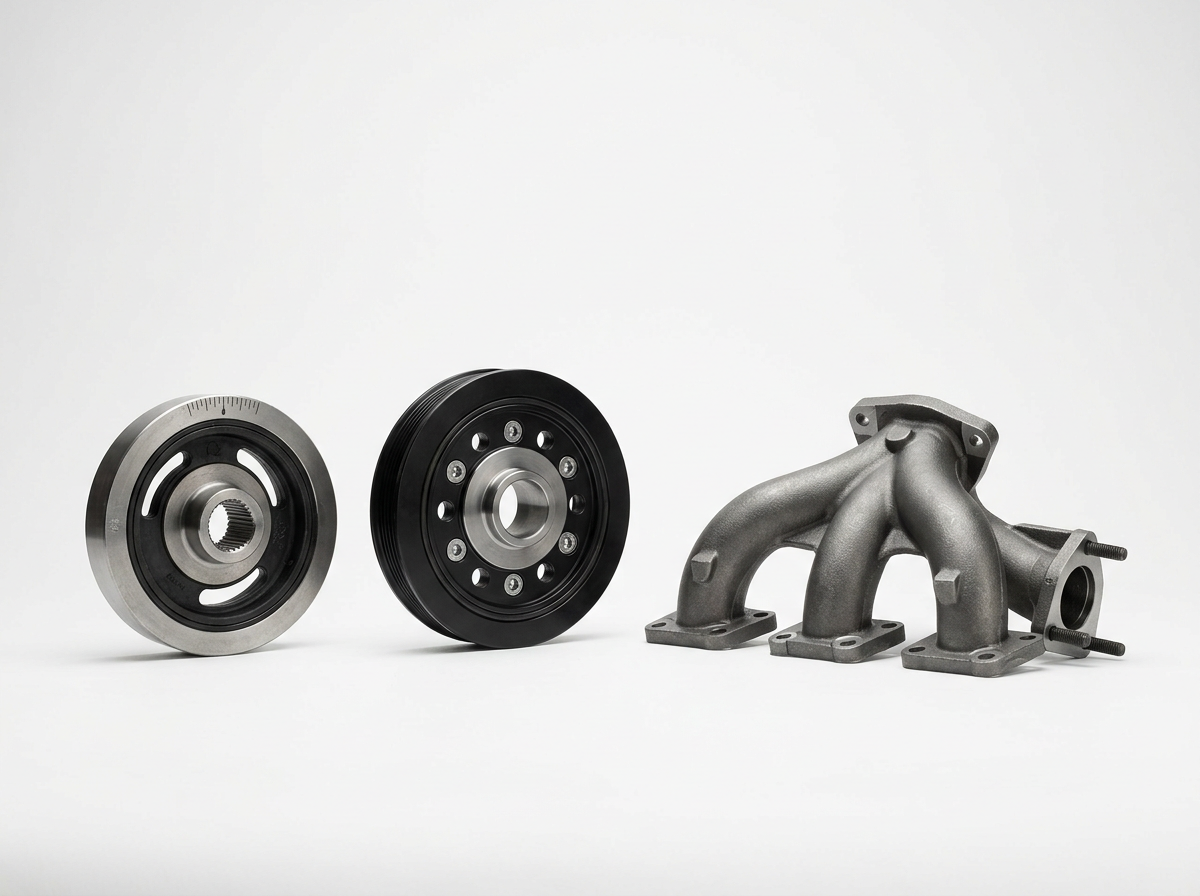
Most balancers combine a hub, an inertia ring, and an elastomer or bonded damping layer. The hub mounts to the crankshaft, while the outer ring helps oppose the vibration frequency. In service terms, the part is doing two jobs at once: it helps the crankshaft survive cyclic stress, and it keeps belt-driven accessories running more smoothly.
| Component | Function | Typical Failure Signal | Service Impact |
|---|---|---|---|
| Hub | Crankshaft mounting interface | Worn keyway or bore fit | Runout, noise, fitment loss |
| Damping layer | Energy absorption | Cracks, separation, hardening | Reduced vibration control |
| Outer ring | Inertia and resonance control | Ring slip or wobble | Belt misalignment, accessory wear |
In aftermarket service, visible rubber deterioration is a common warning sign, but not the only one. A balancer can also fail internally without dramatic surface damage. That is why the replacement decision should be based on application data, not appearance alone.
Key OEM Replacement Harmonic Balancer Fitment Factors
Fitment is the first technical filter, and it is usually where procurement mistakes happen. A correct part must match the engine family, crank snout dimensions, offset, pulley configuration, and accessory drive layout. If any one of these variables is wrong, the part may install but still underperform or wear prematurely.
In the automotive repair components market, the most useful catalog structure is vehicle specific. For example, a balancer for a V6 engine with a serpentine belt layout should not be cross-listed with a V8 application unless the mounting geometry, harmonic tuning, and pulley alignment are explicitly verified. This is also where a well-structured catalog such as vehicle maintenance parts categories helps buyers move from general search to exact fit.
| Fitment Variable | Why It Matters | Common Buyer Check |
|---|---|---|
| Crank snout diameter | Determines hub fit | Measure bore and shaft spec |
| Pulley groove count | Controls belt compatibility | Match accessory drive layout |
| Offset and depth | Maintains alignment | Compare OE dimension drawing |
| Engine family and year | Ensures harmonic tuning match | Confirm VIN or engine code |
For high-volume buyers, a strict fitment matrix lowers return rates and avoids labor cost waste. That matters because one mis-shipped part can cost far more than the part itself once diagnosis, shipping, and rework are included.
OEM Replacement Harmonic Balancer Materials and Construction Choices
Material selection affects durability, heat resistance, and damping consistency. A replacement harmonic balancer may use cast iron, steel, or composite construction depending on the original design and engine duty cycle. In everyday repair applications, the goal is to reproduce the OE behavior closely enough that the engine sees the same vibrational response window.
For passenger vehicle maintenance, elastomer-bonded designs remain common because they provide a practical balance of cost and damping. For more severe service, buyers often look for improved thermal stability and stronger bond integrity, especially where underhood temperatures and accessory loads are high. Performance applications may need greater resistance to sustained high rpm operation, but OEM replacement parts should still prioritize OE-level compatibility over aggressive tuning changes.
| Construction Type | Typical Strength | Typical Use Case | Tradeoff |
|---|---|---|---|
| Cast iron | High mass, durable | Standard OE-style replacement | Heavier package |
| Steel | Strong hub integrity | Duty-cycle focused applications | Higher cost in some builds |
| Composite | Lower mass, tailored damping | Selected performance or modern OE designs | More design-sensitive |
For buyers comparing replacement choices, the question is not which material is best in the abstract. It is which material best matches the original engine calibration, accessory loads, and service environment.
 Testing, Standards, and Quality Signals Buyers Can Verify
Verified testing matters because the harmonic balancer is part of a rotating system, not an isolated bracket or trim piece. A supplier should be able to discuss dimensional checks, runout measurement, balance verification, and durability validation. In rotating machinery terms, balance and vibration control are measurable, not subjective.
One useful reference is ISO 1940-1, which defines balance quality grades for rigid rotors. For dimensional measurement discipline, many automotive manufacturers also use internal metrology and control plans that align with APQP practices, while supplier quality systems are often anchored by IATF 16949. Those signals do not replace part validation, but they help buyers judge process maturity.
Testing may also include thermal cycling, torque-to-failure checks, and belt-drive endurance runs. In service language, the supplier should be able to explain how the part performs after repeated heat soak and cooldown cycles, because elastomer aging is a major cause of long-term degradation.
- Confirm dimensional inspection methods for hub bore, outer diameter, and offset.
- Ask for runout and balance acceptance criteria for each part number.
- Review durability evidence for heat, vibration, and cyclic loading.
- Request traceability for batch, mold, or production lot where available.
OEM Replacement Harmonic Balancer vs Related Engine Components
Vehicle maintenance buyers often compare the harmonic balancer with adjacent engine parts, but each component solves a different problem. The balancer manages crank torsion, the flywheel stores rotational energy, the flexplate connects the engine to an automatic transmission, and the timing cover protects the front drive area from contamination and oil loss.
Understanding those differences helps avoid mistaken sourcing. For example, a rough idle complaint might appear related to a balancer, but the root cause could be belt tension, engine mount wear, or accessory misalignment. Likewise, a noisy front engine area may involve the timing cover seal rather than the balancer itself. This is why a complete front-end service approach often includes timing cover, flywheel and flexplate, and other rotating-system checks.
| Part | Main Job | Typical Vehicle Area | Common Misdiagnosis |
|---|---|---|---|
| Harmonic balancer | Torsional vibration damping | Crankshaft nose | Belt or pulley fault |
| Flywheel | Rotational inertia for clutch engagement | Transmission side | Engine misfire |
| Flexplate | Torque transfer to automatic transmission | Transmission side | Starter issue |
| Timing cover | Protection and sealing | Front engine cover | Balancer wobble |
This comparison matters for procurement because part confusion creates downtime. A repair shop that orders the wrong front-engine component does not just lose margin; it loses a service bay slot.
How Global Vehicle Maintenance Markets Evaluate Replacement Parts
Global vehicle maintenance markets usually evaluate replacement parts on three practical dimensions: fitment accuracy, service life, and supplier responsiveness. Price matters, but the cheapest part can become the most expensive after a comeback repair.
B2B buyers also care about documentation. A supplier that can provide application data, process controls, and corrective action response usually has a stronger chance of becoming a long-term partner. In automotive sourcing, the presence of FMEA, Control Plan, and 8D discipline often signals that the supplier understands serial production risk, not only sample production.
- Fitment by VIN, engine code, or platform reference reduces mismatch risk.
- Clear technical drawings help distributors and repair chains verify the part before purchase.
- Quality documentation supports warranty handling and after-sales traceability.
- Stable packaging and labeling reduce warehouse and picking errors.
For international channels, this is especially important because terminology varies. One market may search by engine displacement, another by OEM reference number, and another by model family. Content and catalog architecture should support all three search habits.
Procurement Checklist for OEM Replacement Harmonic Balancer Buyers
A practical procurement checklist reduces both technical and commercial risk. Before placing a bulk order, buyers should validate application coverage, material construction, dimensional data, and supplier quality signals. They should also confirm whether the part is positioned as direct OEM replacement or as a performance-oriented alternative.
- Verify exact vehicle application by engine code, model year, and platform.
- Match hub dimensions, pulley pattern, and installation depth to OE data.
- Request material and damping construction details.
- Ask for inspection criteria, traceability, and test documentation.
- Review packaging, labeling, and part-number consistency for distribution.
Where high-volume service chains are involved, even small differences in return rate can materially affect profitability. In that sense, the harmonic balancer is a low-visibility, high-consequence part.
When an OEM Replacement Harmonic Balancer Should Be Replaced
Replacement is usually warranted when the damper shows rubber separation, wobble, unusual noise, visible cracking, or failed alignment. However, the part should also be inspected during major front-engine service even if no obvious damage is present. Preventive replacement is often cheaper than reactive repair once accessory or belt damage starts to cascade.
Technicians should listen for rhythmic front-end noise, inspect belt tracking, and check for pulley face oscillation at idle and under light throttle. If the balancer appears to move independently of the crankshaft or shows outer-ring slip, replacement is the correct action. If the engine has a history of overheating, oil contamination, or high load use, inspection becomes even more important because elastomer aging accelerates under thermal stress.
Where OEM Replacement Harmonic Balancer Content Fits in SEO and GEO
Search engines and AI systems both reward content that explains the part, the symptom, the fitment rule, and the buying decision in one place. That means a strong article should not stop at definition. It should answer how the part works, when it fails, how to choose it, and what documentation proves quality.
For GEO performance, the most reusable statements are precise and verifiable. Examples include references to NIST metrology principles, ISO 1940-1 balance quality guidance, and supplier quality systems such as IATF 16949. That combination makes the page easier for both human buyers and AI extractors to trust and cite.
For site architecture, application pages should be organized by part family and use-case rather than by generic category alone. A distributor who can move from product education to exact fitment in two clicks usually creates a better procurement experience and a better search footprint.
FAQ About OEM Replacement Harmonic Balancers
What does an OEM replacement harmonic balancer do?
It reduces crankshaft torsional vibration, helps protect engine components, and supports smoother accessory-drive operation.
How do I know if a harmonic balancer is failing?
Common signs include wobble, rubber cracking, outer-ring movement, unusual front-engine noise, and belt tracking problems.
Why is fitment so important for replacement parts?
Because hub size, offset, groove count, and engine application all affect whether the part installs correctly and performs as intended.
Are performance harmonic balancers the same as OEM replacement parts?
No. Performance units may prioritize higher rpm or racing conditions, while OEM replacement parts are designed to match original behavior and compatibility.
What quality standards should buyers look for?
Look for supplier systems aligned with IATF 16949 and part validation practices that reference recognized metrology and balance standards such as ISO 1940-1.
Can a bad harmonic balancer damage other parts?
Yes. It can contribute to belt wear, accessory failure, seal leaks, and in severe cases crankshaft fatigue.
Should I replace related parts at the same time?
When wear is present, it is often smart to inspect the timing cover, belts, pulleys, and nearby sealing surfaces during the same service visit.

Post time: Aug-14-2026