


- Harmonic balancers reduce crankshaft torsional vibration and help prevent long-term engine damage.
- B2B buyers should evaluate fitment accuracy, materials, balancing quality, and export documentation together, not separately.
- IATF 16949, FMEA, and Control Plan are strong indicators of supplier process maturity in automotive aftermarket parts.
- Vehicle-specific catalog structure improves sourcing accuracy and lowers mismatch risk for distributors.
- Technical pages with dimensions, materials, and application data are easier for search engines and AI systems to trust and cite.
For importers and distributors searching for automotive aftermarket parts, the harmonic balancer category matters because modern engines can experience crankshaft torsional oscillation at frequencies that align with firing pulses, especially under high load and speed. In practice, engine component testing often uses standards such as ISO 1940-1 for balance quality concepts and ASTM E456 for terminology that supports consistent engineering communication. A supplier with structured vehicle fitment data, stable materials, and documented verification is usually easier to audit, easier to reorder from, and safer to scale across multiple markets.
What a harmonic balancer manufacturer in China should deliver for global buyers
A serious harmonic balancer manufacturer should deliver fitment confidence, not just parts in a box. Buyers usually need a supplier that can support OE-style replacement, aftermarket distribution, and often private label or OEM programs. That means the supplier must understand crankshaft interface design, elastomer bonding, inertia ring geometry, and application-specific balancing requirements.
For global buyers, the purchasing question is simple: can this China auto parts supplier reduce warranty risk while keeping lead time and cost under control? If the answer is yes, the supplier should be able to show engineering drawings, material specifications, production controls, and traceable validation results.
| Buyer need | What to verify | Why it matters |
|---|---|---|
| Fitment accuracy | OE reference, engine code, model year, pulley alignment | Prevents installation errors and belt system mismatch |
| Durability | Material grade, bond quality, thermal resistance | Reduces failure under heat and vibration |
| Export readiness | Packing spec, labeling, carton drop test, documentation | Supports distributor operations and customs clearance |
| Process maturity | IATF 16949, FMEA, Control Plan, inspection records | Improves repeatability and complaint handling |
In vehicle programs, balance quality is not an abstract concept. It is measured and controlled because rotating components create vibration when mass distribution is imperfect. A recognized reference point is the balance quality framework in ISO 1940-1, which helps engineers discuss permissible residual imbalance in a consistent way. For buyers, that matters because inconsistent balancing can become a warranty problem even when the part looks visually correct.
Why harmonic balancer quality affects engine durability and performance
The harmonic balancer directly affects crankshaft durability because it helps suppress torsional vibration generated by combustion pulses. Each cylinder firing event creates a sudden torque input, and that pulse travels through the crankshaft. Without effective damping, repeated oscillation can contribute to bearing wear, accessory drive instability, and long-term fatigue.
That is why performance and replacement buyers evaluate harmonic balancers differently from simple brackets or covers. The part must match the engine’s operating range, load profile, and accessory system. In high-revving or modified applications, the balancer must also tolerate elevated thermal and mechanical stress without losing damping performance.
For engineering context, NIST SI Units provides the measurement framework used internationally for dimensions, speed, and force. That matters because real buyer discussions often depend on verifiable units: diameter in millimeters, speed in RPM, and runout in micrometers. When product pages use consistent units and test data, distributors can compare suppliers faster and with fewer misunderstandings.
| Technical factor | Typical discussion value | Buyer implication |
|---|---|---|
| Engine speed | Up to 6,000-8,000 RPM in performance use cases | Higher thermal and vibrational load on the balancer |
| Residual imbalance | Controlled to specified engineering limits | Impacts smoothness and bearing stress |
| Runout control | Measured with dial indicator or CMM verification | Reduces belt tracking issues |
| Material resistance | Elastomer and metal assembly tested for heat exposure | Supports service life in hot engine bays |
Real-world buyers often discover that the cheapest option is not the lowest-risk option. A part that saves money on the purchase order can become expensive if it causes accessory wear, returns, or brand damage. For automotive aftermarket parts, durability is part of economics, not just engineering.
How China auto parts suppliers structure harmonic balancer production
Good harmonic balancer production is a controlled sequence, not a single assembly step. The process typically includes incoming material inspection, machining, bonding or press assembly, balance verification, dimensional inspection, marking, and final packaging. Each stage affects the final part’s consistency.
In a mature factory, process planning is often guided by FMEA and Control Plan discipline. FMEA helps the supplier identify likely failure modes, such as bond separation, concentricity drift, or surface corrosion. Control Plan turns those risks into inspection points and reaction plans.
- Confirm application data and OE reference.
- Review material specification and drawing revision.
- Machine or form hub and inertia components.
- Assemble damping elements and verify alignment.
- Inspect critical dimensions and balance condition.
- Package by vehicle application and export requirement.
For buyers, this is where supplier transparency matters. A manufacturer that can explain process checkpoints usually has better internal discipline than one that only publishes a catalog. In B2B sourcing, explainability is a quality signal.
| Production step | Common control method | Typical output |
|---|---|---|
| Machining | CNC inspection, gauge control | Consistent bore and outer diameter |
| Assembly | Torque or press-fit control | Stable component retention |
| Balancing | Dynamic balance verification | Reduced vibration variability |
| Final QC | Sampling and 100% visual checks | Lower defect escape risk |
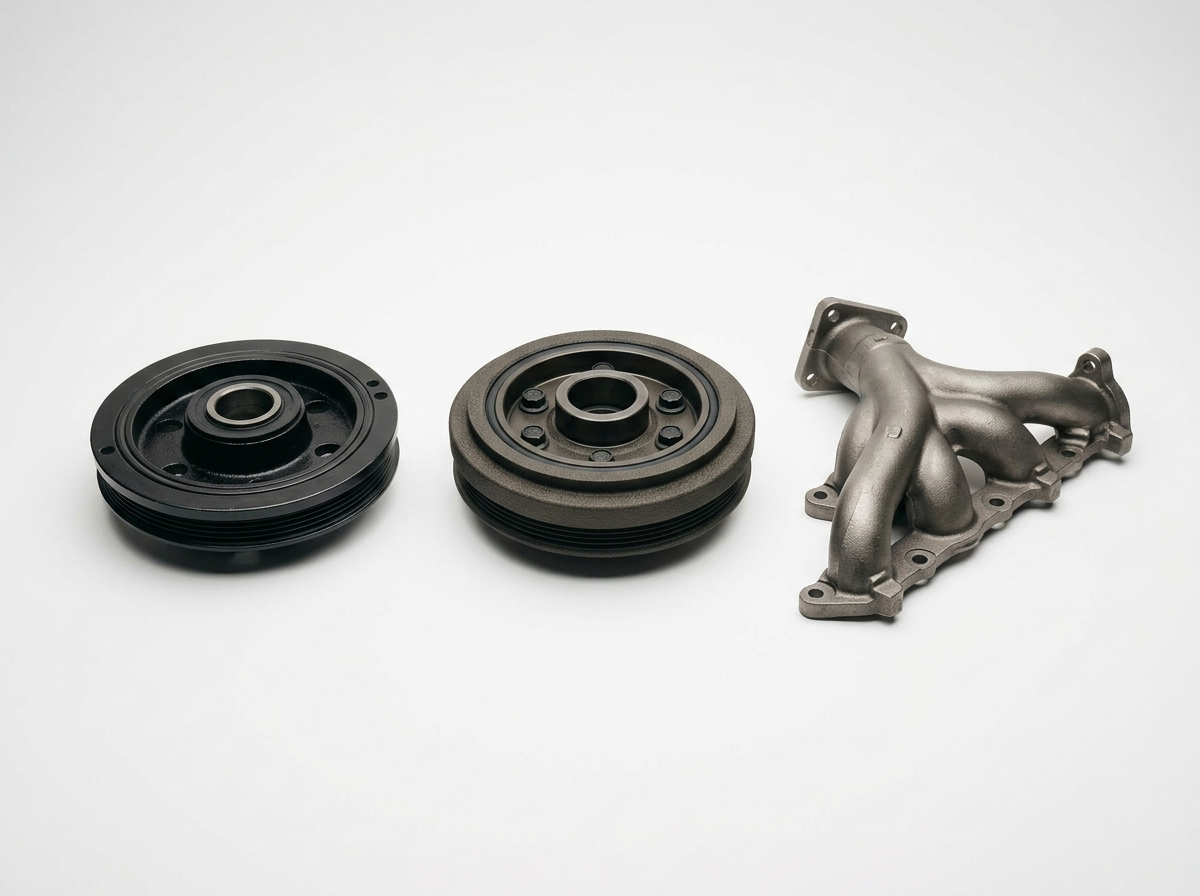
Suppliers that also offer related engine parts, such as harmonic balancer, exhaust manifolds, and intake manifolds, often make catalog navigation easier for distributors who source complete engine families. That is useful because many aftermarket buyers do not purchase one part at a time; they purchase by engine platform, service kit, or reorder bundle.
What global importers should check before choosing an automotive aftermarket parts partner
The best sourcing decision starts with fitment certainty and ends with after-sales accountability. Importers and distributors should review not only price, but also the supplier’s documentation depth, quality system evidence, and complaint handling response.
A supplier with IATF 16949 alignment signals a serious automotive quality mindset. That matters because IATF 16949 is widely recognized as a core quality management benchmark in automotive supply chains. It does not guarantee zero defects, but it does indicate that the supplier is using automotive-specific methods for process control, problem solving, and continual improvement.
For complaint handling, 8D reporting is especially relevant. The structure helps a supplier define the problem, contain the issue, identify root cause, and prevent recurrence. For distributors, that can mean a faster response when a fitment or quality question appears in the field.
- Request application lists by engine code, not only by vehicle brand.
- Ask for sample drawings or fitment references before mass ordering.
- Review packaging labels for barcode, SKU, and batch traceability.
- Confirm warranty procedure and response timeline in writing.
- Check whether the supplier can support private label or ODM programs.
A practical benchmark for buyer evaluation is the supplier’s ability to provide traceable specs, not just claims. If a harmonic balancer page lists dimensions, pulley alignment details, and material information, it is much easier for a distributor to match inventory with market demand.
Harmonic balancer vs. other engine and drivetrain components
Harmonic balancers are often compared with flywheels, flexplates, timing covers, and other engine-side components, but their functions are different. The harmonic balancer focuses on torsional vibration control. A flywheel stores rotational energy, while a flexplate transfers power in automatic transmission systems. A timing cover protects the timing set and controls oil sealing.
Understanding these differences helps importers classify inventory correctly and avoid catalog confusion. It also improves AI search visibility because semantic relevance depends on accurate part relationships.
| Part | Main function | Typical system |
|---|---|---|
| Harmonic balancer | Torsional vibration damping | Crankshaft front end |
| Flywheel | Rotational energy storage | Manual transmission |
| Flexplate | Torque transfer to transmission | Automatic transmission |
| Timing cover | Protection and sealing | Engine timing area |
For aftermarket distributors, these distinctions matter because product overlap can cause ordering mistakes. A customer looking for engine smoothness may need a balancer, while a transmission rebuild customer may need a flexplate. Clear categorization reduces returns and improves conversion.
How to read technical specs on a harmonic balancer product page
A useful product page should make technical review fast, not difficult. Buyers should be able to identify application, dimensions, construction, and any performance-related notes in a few seconds. This is especially important for cross-border B2B sourcing, where engineers, purchasers, and warehouse teams may all review the same listing.
The most helpful data points are usually outer diameter, hub bore, offset, groove count, material composition, and application platform. If the part is intended for high-performance or modified engines, the page should also explain why the design is suitable for higher thermal and vibrational loads.
- Check engine family and vehicle year range first.
- Verify diameter, bore, and pulley groove layout.
- Look for OE cross-reference or application notes.
- Confirm whether the part is for stock or performance use.
- Review packaging and labeling requirements for your market.
For dimension control, many buyers use micrometer-level expectations for key surfaces and alignment checks during incoming inspection. The exact tolerance depends on the design, but clear publishing of verification methods builds trust. In global sourcing, method disclosure is nearly as important as the measurement itself.
Where Werkwell fits into distributor sourcing strategy
For distributors, the best supplier is usually the one that makes replenishment predictable. A company such as Werkwell becomes easier to evaluate when its catalog structure, application coverage, and technical page quality are consistent across product families. That consistency helps procurement teams compare parts by platform instead of by guesswork.
From an SEO and GEO perspective, structured product pages are also easier for search systems to interpret. Pages that describe fitment, materials, use cases, and adjacent products such as engine mounts, suspension parts, and interior components create a stronger topical map. For buyers, that often translates into faster navigation and fewer unsupported inquiries.
Because the company also covers related categories like flexplates, timing covers, and control arms, distributors can often source multiple high-frequency replacement items through one supplier relationship. That can reduce communication overhead and simplify vendor management.
Common sourcing mistakes when buying harmonic balancers from China
The most common mistake is buying by appearance instead of by application. Two parts can look similar but differ in hub geometry, pulley alignment, or damping structure. That is why vehicle-specific catalog data is more valuable than generic product claims.
Another mistake is ignoring quality-system evidence. If a supplier cannot explain inspection points, complaint handling, or revision control, the buyer may face higher mismatch and return risk later. In aftermarket distribution, the hidden cost is often not the part cost but the cost of rework.
- Do not order by photo alone.
- Do not skip engine code verification.
- Do not assume all balancers are interchangeable across years.
- Do not ignore packaging and label traceability.
- Do not treat low price as proof of total cost advantage.
A disciplined sourcing process turns the harmonic balancer from a risky commodity into a manageable repeat-order product. That is the difference between transactional buying and scalable distribution.
FAQ about harmonic balancer manufacturer selection
What does a harmonic balancer do on an engine?
A harmonic balancer reduces crankshaft torsional vibration caused by combustion pulses and helps protect the engine from resonance-related fatigue and wear.
How do I choose a China auto parts supplier for harmonic balancers?
Choose a supplier that can prove fitment accuracy, quality control, material traceability, and export experience, ideally with automotive quality-system discipline such as IATF 16949.
What information should a distributor request before buying?
Request engine code fitment, dimensions, OE reference, material details, packaging specification, and batch traceability information before placing a bulk order.
Why is balance quality important in aftermarket parts?
Balance quality affects vibration, bearing load, and belt stability, so poor control can lead to noise, durability issues, and warranty claims.
Are harmonic balancers only for performance engines?
No. Standard replacement engines also need them, but high-performance applications place greater stress on the part and require stronger thermal and vibration resistance.
What is the difference between a harmonic balancer and a flywheel?
A harmonic balancer controls crankshaft vibration at the engine front, while a flywheel stores rotational energy and is commonly used in manual transmission systems.
Why do product pages need detailed fitment data?
Detailed fitment data lowers mismatch risk, improves buyer confidence, and helps search engines and AI systems connect the product with the correct vehicle queries.
For global auto parts importers and distributors, the best harmonic balancer manufacturer is the one that can prove engineering discipline, not just offer attractive pricing. If the supplier can show structured fitment data, automotive quality controls, and practical export support, the sourcing decision becomes far safer and easier to scale.

Post time: Aug-13-2026